
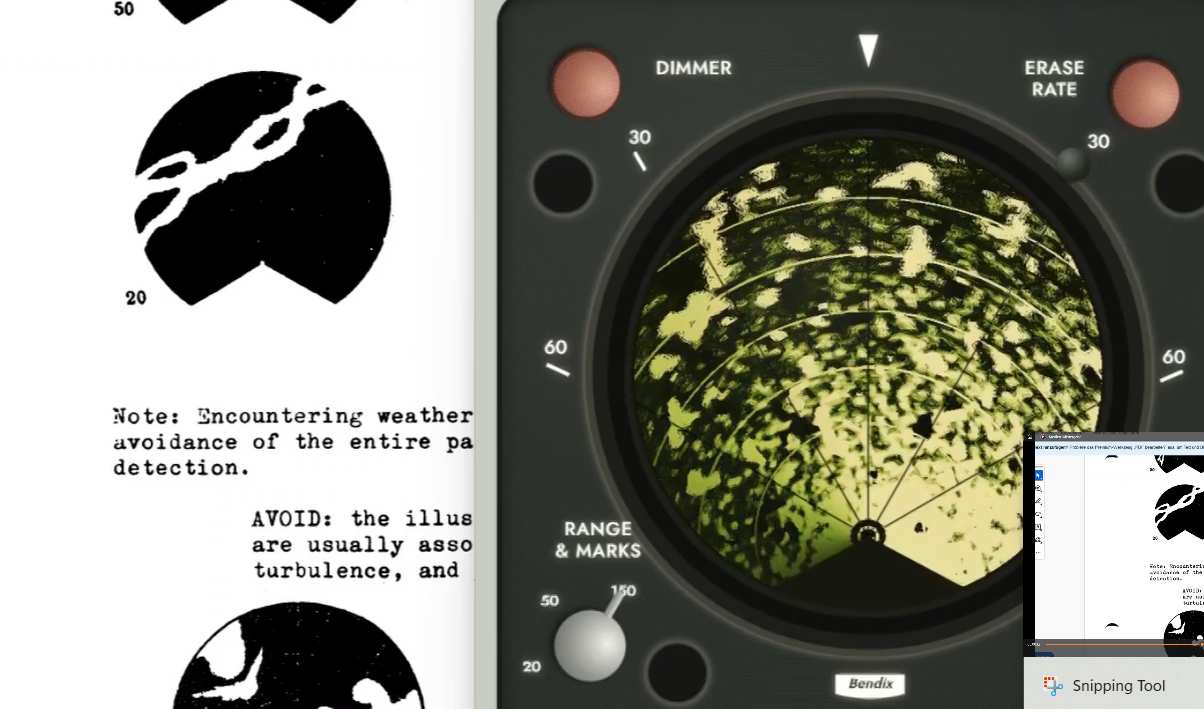
This week I started on the weather radar, the Bendix RDR-1E as installed in the Lufthansa 707s. The goal is to recreate not just a generic radar picture but the actual look and behavior of the 1960s unit, driven by live weather from X-Plane 12.
The source material
Everything is based on original Lufthansa documents: the Lufthansa Technical School training manual, and the flight operations manual. I also used a high-resolution photo of a real indicator. From these I wrote a full system specification covering antenna, receiver, indicator, operating modes, power supply and a catalog of 25 instructor-selectable faults. The faults are taken from the manual’s normal and abnormal display illustrations: stabilization errors, spoking, AFC problems, a dead receiver and more.
What makes this radar special
The RDR-1E doesn’t use a normal phosphor CRT but a viewing storage tube. A writing gun charges a storage mesh, and a flood gun makes the stored image visible, bright enough for daylight. Targets stay on screen until the charge is erased, and the ERASE RATE knob sets that time up to about 60 seconds. The tube’s brightness curve is extremely steep, so weather appears as nearly solid yellow-white shapes rather than the soft green glow most sims show.
The geometry is unusual too. The antenna rotates a full 360° at 15 rpm, but the display origin sits well below the center and shows only a 240° sector. The rear is blanked by a V-shaped notch. I measured the exact proportions, range ring spacing and colors from the original photo.
The optics prototype
To get the look right before writing C# code, I built an interactive web prototype of the PPI-1E indicator and the CON-1N control panel. It simulates:
- the rotating beam writing into a storage buffer, with erase rate, trace adjust and “bloom” when brightness is set too high
- sensitivity time control (STC), receiver noise and auto gain
- the Iso-Echo CONTOUR mode, which punches black holes into storm cores more than 21 dB above threshold
- beam geometry with 3° beam width, antenna tilt, earth curvature, weaker echoes from ice crystals above the freezing level, and rain attenuation at X-band
- ground clutter, the altitude ring, water vs. land returns, and the cosecant² beam in MAP mode for coastlines
- warm-up timing (3 min STBY, then 10–30 s to picture) and the original self-test pattern
- a “tube only” view meant for a round LCD in the cockpit
Next steps
Next I’ll compare the prototype against the real photo, then port the renderer to the simulator in C#. After that comes an X-Plane 12 plugin that samples real weather (precipitation, cloud layers, terrain) around the aircraft and feeds it to the radar. stay tuned!
