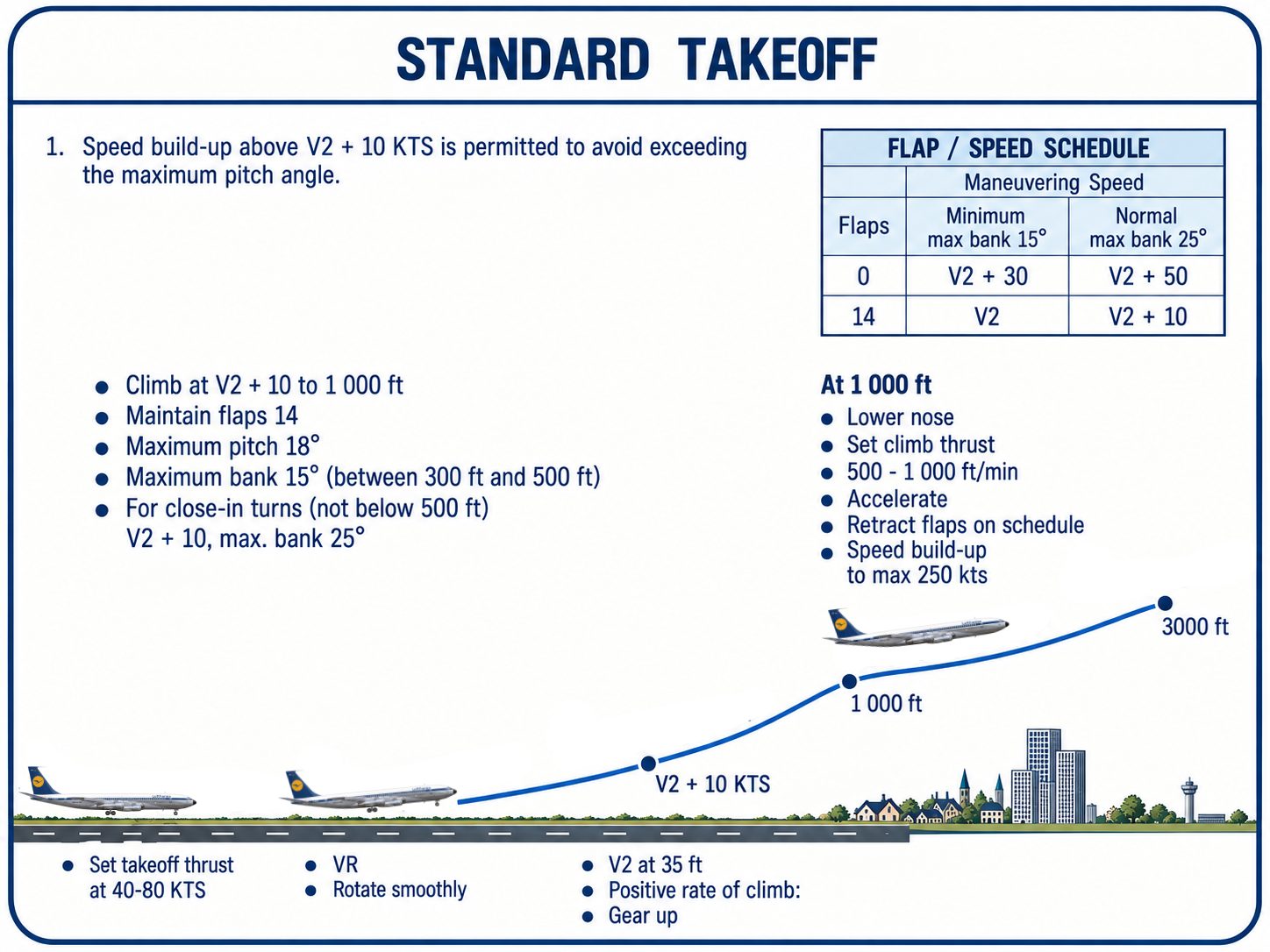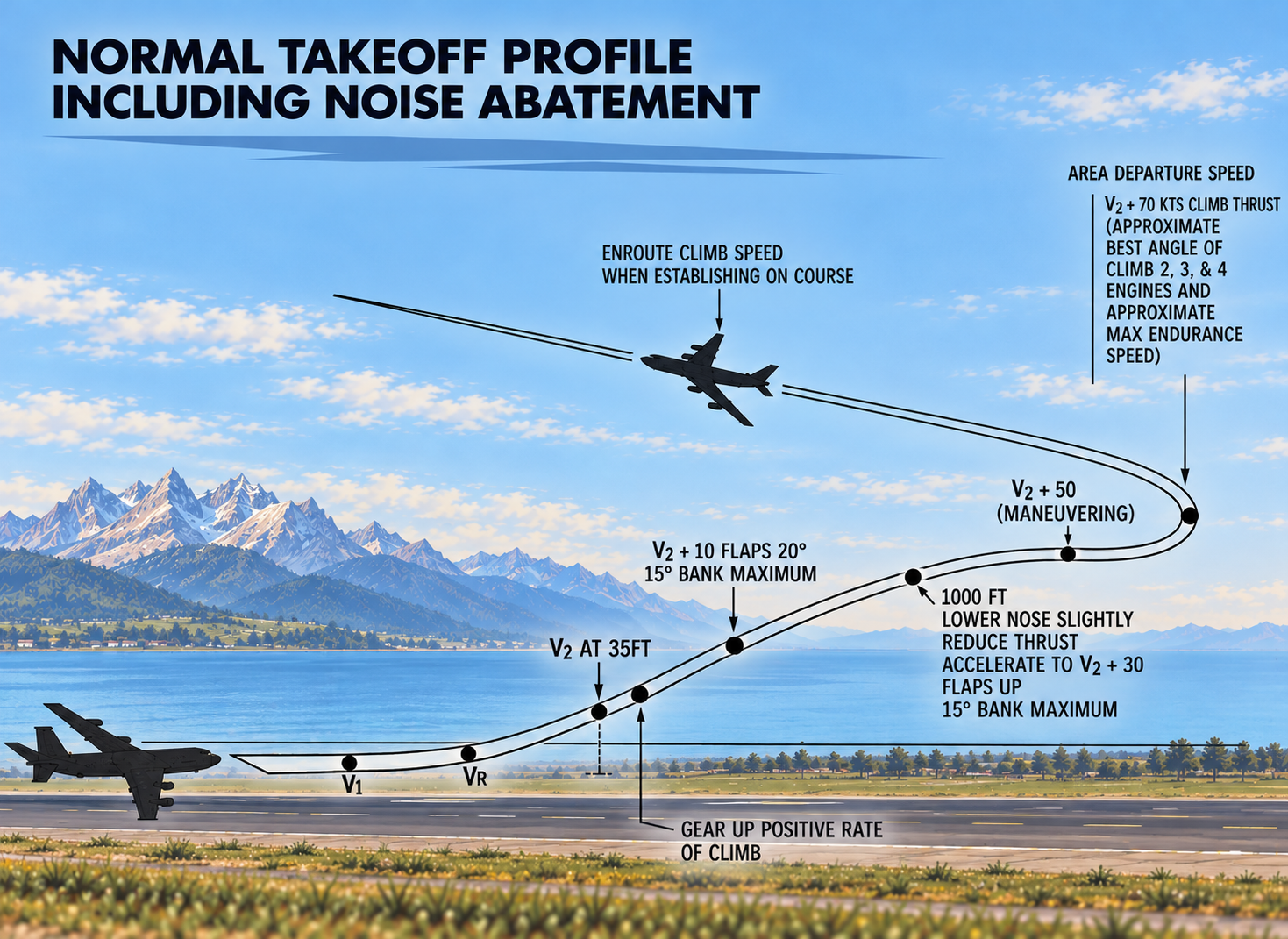

TAKE OFF ROLL – ESSENTIAL CREW DUTIES
-
Before brake release:
CM1 sets about 70–80% N1 (1.2–1.4 EPR). -
40 to 80 KTS:
CM3 adjusts thrust to takeoff EPR. - Rudder becomes effective 40-60 kts
-
After 80 KTS:
Do not adjust thrust anymore unless a limit is exceeded. - The CM1’s left hand on the nose wheel
steering until approximately 80 KTS while
CM2 holds stick fwd. -
Until V1:
CM1 keeps a hand on the throttles & slight foward pressue on control wheel. -
CM3 duties:
Monitor the engine instruments.
Up to 80 KTS, call out abnormal readings.
After 80 KTS, call out only failures that are critical for continuing the takeoff safely.
ROTATION and INITIAL CLIMB
- As the airspeed approaches VR move the control column to a neutral position.
- At VR, rotate the aircraft smoothly to a takeoff attitude of approximately 8° to 9° body angle.
- The aircraft will normally lift off before reaching V2 and attain V2 at 35ft above the runway or 3 seconds after liftoff
- Continue the rotation smoothly into the initial climb attitude to attain V2 + 10 (max pitch 18° – speed build-up permitted @18°)
- Avoid abrupt, early, late, or excessive rotation.
- Maintain a smooth and stable climb attitude.
- Follow the required climb profile and any applicable noise abatement procedure.
GEAR RETRACTION
- Retract the landing gear only after a positive rate of climb is indicated.
- Because of ground effect, the altimeter and vertical speed indicator may not show a positive climb until the aircraft is about 35 to 50 ft above the runway.
- Do not rush gear retraction.
- Gear retraction temporarily increases drag because the gear doors are open during the retraction cycle.
- Undue haste in retracting the gear is neither necessary nor desirable.
- Do not apply brakes after lift-off.
- When the gear handle is selected UP, reduced braking is applied automatically.
- Manual brake application after becoming airborne may damage the snubbers and leveling cylinders.
Late rotation
- Late rotation usually happens when the pilot reacts too slowly after the VR callout.
- This may result in rotation 4 to 8 knots above VR.
- The aircraft may lift off at or above V2.
- Late rotation is especially critical when:
- runway length is limiting,
- obstacles are limiting,
- a noise abatement climb is required.
- Consequences of late rotation:
- longer takeoff roll,
- excessive speed,
- climb path below the predicted profile.
Early rotation
- Rotating too early may cause the aircraft to lift off below normal lift-off speed.
- The rate of climb will be lower.
- The aircraft will reach 35 ft later than predicted.
- The expected takeoff flight path will not be maintained.
- Early rotation may also extend the takeoff roll.
Over-rotation
- Over-rotation increases drag and delays acceleration to lift-off speed.
- It may cause buffet and further reduce takeoff performance.
- Over-rotation is often associated with early rotation.
- It can become hazardous, especially because nacelle ground clearance is limited.
- Even a small bank angle may result in nacelle scrape.